Most founders delegate wrong.
They either dump everything on someone who isn't ready and wonder why it goes sideways. Or they refuse to let go of anything because "nobody does it like I do" and wonder why they're working 70 hours a week.
Delegation isn't about finding someone to do your work. It's about deciding which work should exist in the first place, and then putting each task in the hands of the right person or system.
I use a simple framework with every client I coach. I call it the Delegation Matrix. It takes about 30 minutes to build and it will change how you think about your time permanently.
The 4 Boxes
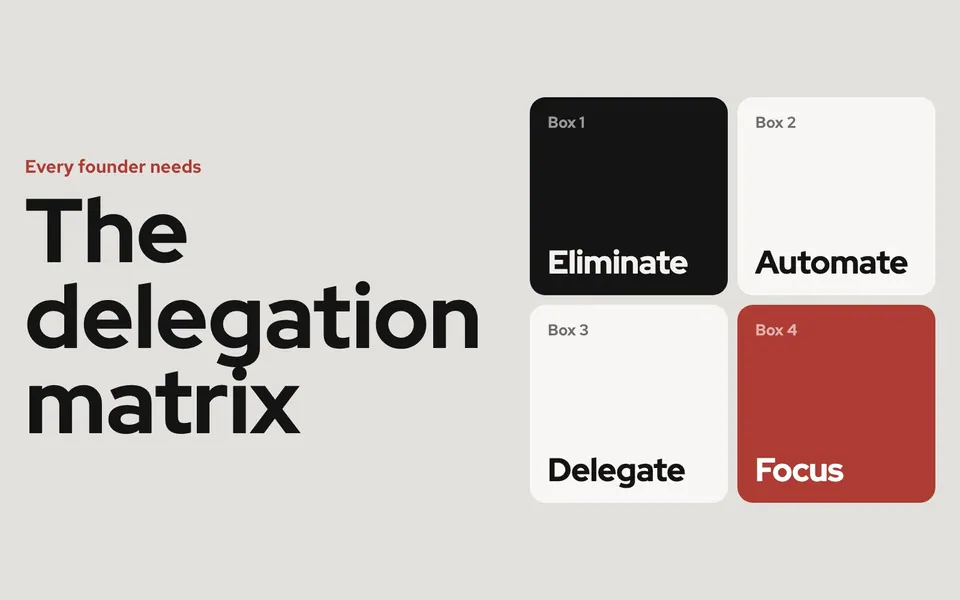
Take a piece of paper and draw a 2x2 grid. Label the four boxes:
Box 1: Eliminate
These are tasks that don't need to happen at all. Reports nobody reads. Meetings that don't produce decisions. Approvals that exist because of habit, not necessity. Processes that were created for a problem that no longer exists.
You'd be shocked how many hours per week founders spend on things that could simply stop happening and nothing would change. This is the first and easiest box. Before you delegate anything, ask: does this even need to exist?
Box 2: Automate
These are tasks that happen repeatedly, follow a predictable pattern, and don't require human judgment. Scheduling. Invoice follow-ups. Data entry. Report generation. Email sequences. Social media posting.
If a task follows the same steps every time, software can probably do it. The tools exist. GoHighLevel, Zapier, n8n, even simple spreadsheet formulas. The investment in setting up the automation pays for itself within weeks.
Box 3: Delegate
These are tasks that need a human but don't need to be you specifically. Customer service responses. Project management. Basic content creation. Vendor coordination. Administrative work. Bookkeeping.
This is where the 80% rule applies. If someone can do it 80% as well as you, delegate it. That remaining 20% gap is not worth your time. Perfectionism is not a standard. It's a trap that keeps you stuck doing work below your pay grade.
The key to successful delegation: don't just hand someone a task. Hand them the outcome you expect, the criteria for success, and the authority to make decisions within their scope. Then step back.
Box 4: Focus
These are the tasks that only you can do. The ones that require your specific expertise, relationships, or authority. Strategy. Closing major deals. Key partnerships. Vision casting. Leadership decisions.
This box should be where you spend 80% or more of your working hours. This is CEO work. Everything else in Boxes 1 through 3 should be eliminated, automated, or delegated so you can live in this box.
How to Build Yours
Step 1. List every task you do in a typical week. Everything. Don't leave anything out, even the small stuff. Especially the small stuff. That's where the hidden time waste lives.
Step 2. Put each task into one of the four boxes. Be ruthless. Your default should be to get things OUT of Box 4, not to keep them there. Most founders overestimate how many tasks truly require their personal involvement.
Step 3. For Box 1 (Eliminate), stop doing those things this week. Just stop. See what happens. In most cases, nothing. Nobody notices. The sky doesn't fall.
Step 4. For Box 2 (Automate), pick the one task that repeats most often and set up the automation. Don't try to automate everything at once. One per week.
Step 5. For Box 3 (Delegate), identify who on your team could take each task. If you don't have someone, this tells you exactly what to hire for next. The delegation matrix becomes your job description.
Step 6. For Box 4 (Focus), block time on your calendar for these items first. Before meetings, before email, before anything else. This is your highest-value work. It gets the best hours of your day.
The 80% Rule
I want to come back to this because it's the thing that trips founders up the most.
When you delegate something, it will not be done exactly the way you would do it. That is guaranteed. And that is fine.
If your ops person handles a client request at 80% of the quality you would have delivered, and it takes them 30 minutes while it would have taken you 30 minutes plus the mental overhead of context switching away from CEO work and back, the math is clear. The 80% solution wins every time.
Your standards matter. But your standards should be applied to outcomes, not to process. Tell people what the result should look like. Let them figure out how to get there. That's how you build a team that thinks, not a team that follows orders.
Start Today
The delegation matrix is not a one-time exercise. It's a lens you apply to your work continuously. Every time you catch yourself doing something that belongs in Box 1, 2, or 3, move it.
Over time, your calendar transforms. The fires shrink. The busywork disappears. And you start spending your days on the things that actually grow the business.
That's not just time management. That's freedom.
Want me to help you build your delegation matrix? In 15 minutes I can identify the highest-impact items to eliminate, automate, and delegate in your business right now.