Let me ask you a question.
How many hours did you spend last week on work that someone making $20 an hour could have done?
Be honest. I'm talking about answering routine emails. Scheduling meetings. Following up on invoices. Updating spreadsheets. Managing a project that someone on your team should own. Sitting in a meeting you didn't need to be in.
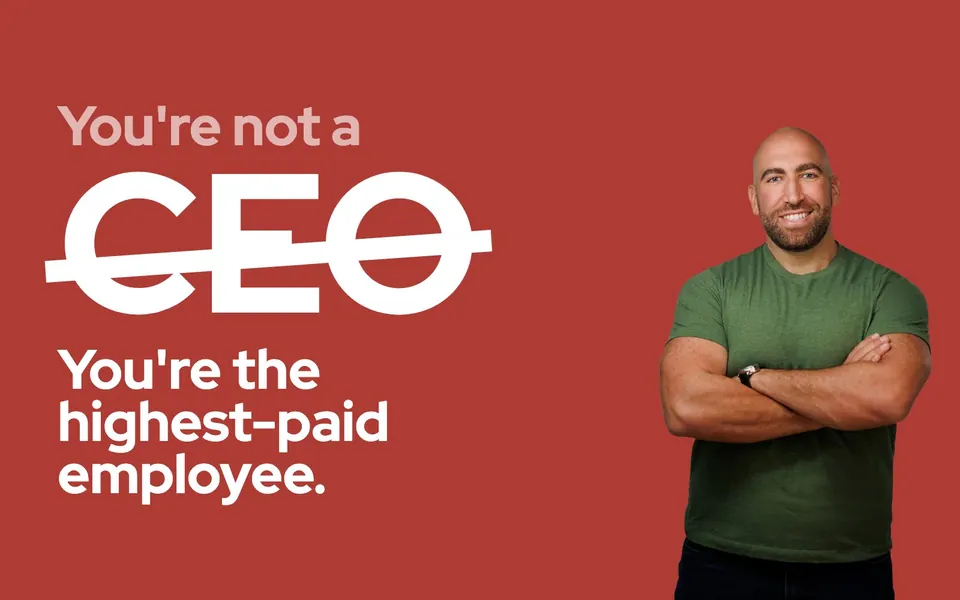
If the answer is more than 10 hours, you're not operating as a CEO. You're operating as the highest-paid employee in your company.
The Difference
A CEO sets direction. They build systems. They make the decisions that shape the future of the business. They spend their time on the things that only they can do. Strategy. Key relationships. Vision. Culture. Closing big deals.
An employee does tasks. They execute work. They follow processes. They handle the day-to-day.
Most founders call themselves CEO but spend their days doing employee-level work. And the worst part is it feels productive. You're busy all day. Your calendar is packed. You're responding to messages, solving problems, putting out fires. At the end of the day you're exhausted and it feels like you accomplished something.
But you didn't. You just did a bunch of things that someone else could have done while the actual CEO-level work went untouched.
The Math
Let's make this real.
If your business does $1.5 million a year and you work 60 hours a week, your time is worth roughly $480 per hour. That's what one hour of your focused, strategic attention is worth to the business.
Now let's say you spend 20 hours a week on tasks that someone making $25 an hour could handle. That's $500 a week in labor cost. Totally reasonable.
But those same 20 hours at your rate? That's $9,600 per week in founder-level productivity you're not spending on growth. Over a year, that's nearly $500,000 in opportunity cost.
You're not saving money by doing things yourself. You're spending the most expensive resource you have on the cheapest work available.
The Audit
Here's what I want you to do this week.
Track every hour for 5 business days. Write down what you did and how long it took. Don't filter it. Don't judge it. Just log it.
At the end of the week, go through the list and put each item into one of two categories:
CEO work. Things that require your specific expertise, relationships, or decision-making authority. Strategy, sales calls, key partnerships, vision setting, team leadership.
Employee work. Everything else. Email, scheduling, project management, data entry, routine meetings, tasks that someone else could do with basic training.
Add up the hours in each category. I guarantee the employee category will be bigger. For most founders I work with, it's 60 to 70 percent of their week.
The Shift
The goal isn't to stop working. It's to stop working on the wrong things.
Take the employee work list and divide it into three groups. Things to eliminate entirely. Things to automate with software. Things to delegate to someone else.
Then start moving those items off your plate. One per week if that's all you can handle. The point is to make progress, not to do it all at once.
Every hour you reclaim from employee work is an hour you can spend on CEO work. And CEO work is what grows the business.
The Hard Truth
If you're doing everything in your business, you don't have a business. You have a job. A stressful, underpaid, never-ending job that you created for yourself.
A real CEO builds a business that doesn't need them in the day-to-day. A business that runs, grows, and serves its customers whether the founder is in the building or on a beach.
That's not a fantasy. That's a system. And it starts with being honest about how you're spending your time.
Stop being the highest-paid employee. Start being the CEO.