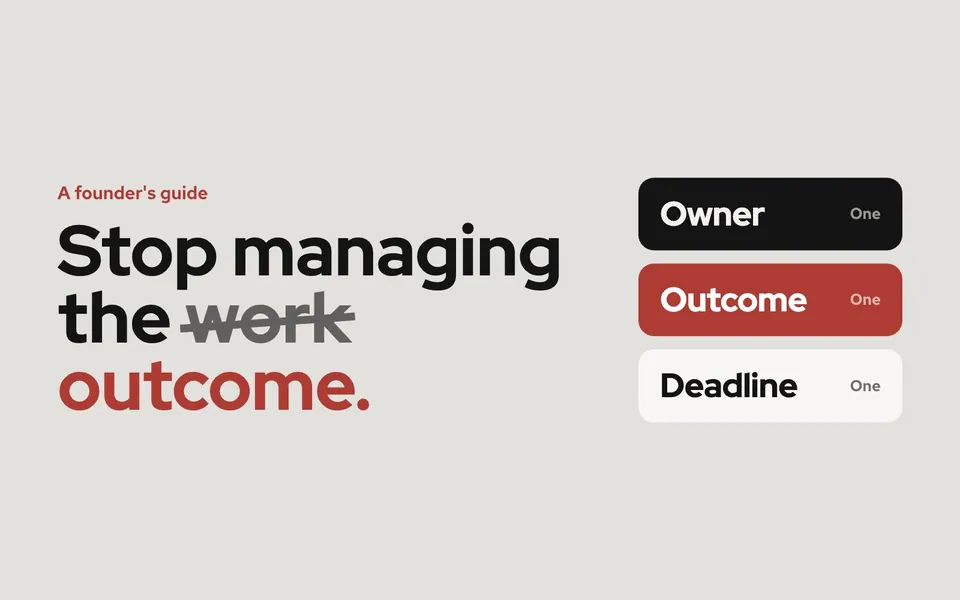
How do I stop micromanaging my team? Stop managing the work and start managing the outcome. Give every task one owner, one outcome and one deadline. Write down the rules you use for your most common decisions and hand those decisions over. Replace random check-ins with one agreed weekly rhythm. Then accept 80% as good enough.
That is the short answer. The longer answer is that micromanaging is rarely a personality flaw. For most founders it is a habit that kept the business alive in the early days and never got switched off. Every one of the 11 businesses I have built hit a ceiling, and every time the ceiling was me. I see the same thing in almost every founder I coach who is doing somewhere between $500K and $5M a year.
Here is how to tell if it is you, why it happens, and the exact steps I use to get founders out of it.
Am I micromanaging, or just being involved?
Being involved means you set direction, agree on what good looks like, and are available when someone needs you. Micromanaging means the work cannot move, or cannot be finished, without you touching it.
Run through this list honestly. If three or more are true, you are micromanaging:
- You check in on a delegated task more than once a day "just to see how it's going."
- You redo work because it was not done "the right way," which usually means your way.
- You keep the final say on things you said you had handed off.
- You are copied on every email and pulled into every meeting.
- Your team asks you questions they could answer themselves, because they have learned that you will change the answer anyway.
- Work stops whenever you are busy, travelling or on vacation.
The last one is the real test. If the business slows down when you step away, you are not overseeing the work. You are part of the machinery.
Why do founders micromanage?
Nobody starts a company planning to become its biggest bottleneck. In year one, doing everything yourself is the only option. You were the best salesperson, the best operator and the best problem solver because there was nobody else. That instinct is what got the business off the ground.
The problem is that the instinct does not turn off on its own. It has to be replaced, on purpose, with different habits. Most founders never make that switch, so they keep running a twenty person company the way they ran a two person company.
Underneath it is usually one belief: "If I don't do it, it won't be done right." That belief is half true. Other people will not do it exactly the way you would. But they will do it about 80% as well, and 80% done by someone else beats 100% done by you when the cost is your whole calendar.
What does micromanaging cost a growing business?
The obvious cost is your time. If every decision runs through you, the company can only move as fast as you can personally process information. When you are maxed out, the business is maxed out.
The bigger cost is your team. A capable person who gets checked on three times a day and has their work redone learns one lesson fast: nothing they do really matters, because you are going to touch it anyway. So they stop trying. Then you point to that as proof that you cannot find good people. HR researchers see the same pattern from the employee side: SHRM's look at micromanagers describes how the style lowers morale and can push talented people to burn out or leave.
I wrote about this in more depth in You Don't Have a Hiring Problem. You Have a Letting-Go Problem. The short version: you did not have a talent problem. You built a system where talent cannot survive.
How do I stop micromanaging? The five steps
This is the order I use with founders. Each step makes the next one easier.
- Give every task an owner, an outcome and a deadline. If a task does not have all three, it will always roll back uphill to you. Say them out loud and write them down. One owner, not "the team." One outcome, described as a result, not a list of steps. One date.
- Hand over the outcome, not the instructions. Tell someone what result you need and by when. Stop handing them a step by step script that leaves room for only one way of doing it: yours. If the process matters, put it in a written process the person can improve, not in your head.
- Write down your decision rules, then give the decisions away. Pick the three decisions you make most often each week. Write down the criteria you actually use to make them. Hand that list to someone on your team along with the authority to decide. Now the decision does not need you; it needs your rules.
- Replace random check-ins with one rhythm. Agree on a weekly check-in for each delegated area, with a short list of what gets reported. Before you reach out between check-ins, ask yourself: is this urgent, or is this me needing to know? Only one of those justifies interrupting someone's work.
- Accept 80% and let it be done wrong before it is done right. The first few times someone owns something new, it will not look the way you would do it. That is not failure. It is the only way anyone learns to own something.
What should I do instead? A side by side
| When you micromanage, you | When you lead, you |
|---|---|
| Hand over steps and watch each one | Hand over a result and a deadline |
| Check in whenever you feel uneasy | Check in on an agreed weekly rhythm |
| Keep the final say on everything | Write down your rules and give the decision away |
| Redo work that is not done your way | Accept 80% and coach the gap |
| Measure whether tasks got done | Measure whether decisions are moving away from you |
| Answer every question yourself | Ask "what would you do?" first |
That fifth row matters more than it looks. A new hire who still needs your sign-off on everything has not taken anything off your plate. You have just added a step.
How do I decide what to let go of first?
Do not try to let go of everything at once. Pick one thing.
Open your calendar from the last two weeks. For every meeting, task and recurring commitment, ask: "If I disappeared tomorrow, could someone else do this?" You will find at least three. Pick the one that eats the most time. That is where you start.
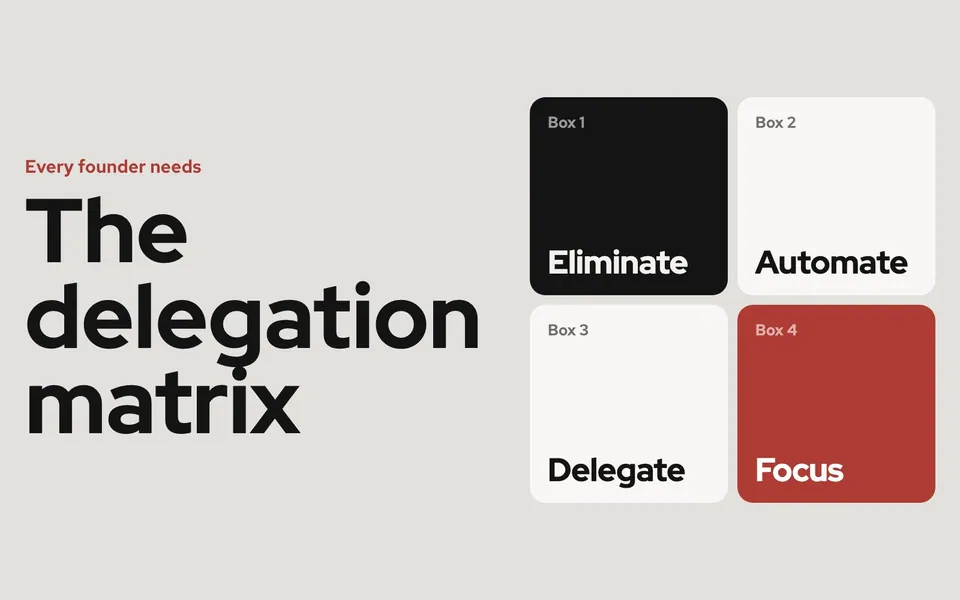
If you want a structured way to sort the rest, the Delegation Matrix splits your work into four boxes: eliminate, automate, delegate and focus. Most of what founders micromanage lives in the delegate box. The Pick One Thing exercise walks through the calendar audit step by step.
When I ran my DJ company, I was booking every gig, running every event and managing every setup. If I did not show up, there was no business. The breakthrough came when I hired my first DJ, then my second, and built a system for booking, setup and delivery that did not need me in the room. I did not get there by trusting people more overnight. I got there by building the system that made trust reasonable.
How long does it take to stop micromanaging?
The habit does not break in a day, but the first proof comes fast. Here is a simple test I give founders: take one week and do not answer a single question your team could plausibly figure out on their own. Not because you have checked out, but because you are giving them room to build a muscle they have never had the chance to use.
Some of that week will be uncomfortable. Some decisions will go a way you would not have chosen. But you will also see who on your team was capable the whole time and just never got the room to prove it.
Removing yourself from one thing proves to you that the business does not collapse when you step back. That gives you the confidence to remove yourself from the next thing, and the next. If that first week feels impossible, the problem was never your team's ability. It was your willingness to find out.
Where to start this week
If you only do one thing: take the next task you hand off and give it one owner, one outcome and one deadline, said out loud and written down. Then hold yourself to the weekly check-in instead of the hallway one.
If you want to know whether micromanaging is your biggest constraint or just a symptom of something else, take the free Founder Bottleneck Scorecard. It takes about two minutes and scores you on decisions, delegation, systems, automation and time, then gives you your number one bottleneck and the first move to fix it.
And if you already know it is you and want help getting out of the way, that is exactly what I do in business coaching. Book a call and we will find the first thing you need to let go of.
Frequently asked questions
How do I know if I am micromanaging?
If three or more of these are true, you are micromanaging: you check in on delegated work more than once a day, you redo work that is not done your way, you keep the final say on things you handed off, you are copied on everything, your team asks you questions they could answer, and work stops when you are away.
Why do founders micromanage?
In the early days, doing everything yourself was the only option, and that instinct kept the business alive. It does not turn off on its own. It has to be replaced, on purpose, with different habits.
What is the first step to stop micromanaging?
Take the next task you hand off and give it one owner, one outcome and one deadline, said out loud and written down. Then hold yourself to one weekly check-in instead of checking in whenever you feel uneasy.
Is it micromanaging to check in on my team?
Not if the check-in is agreed in advance and happens on a set rhythm. Before you reach out between check-ins, ask yourself whether it is urgent or whether you just need to know. Only urgent justifies interrupting someone's work.