Every founder I talk to tells me the same thing. "I need to hire." "I can't find good people." "My team just isn't stepping up."
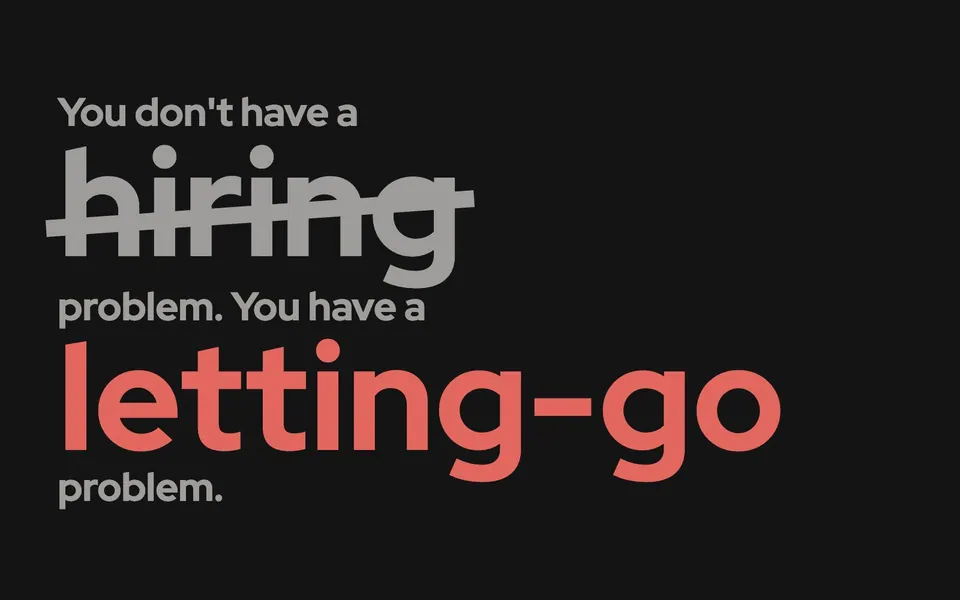
If you've searched "why can't I find good employees" more than once, this isn't a hiring problem. It's a founder bottleneck problem, and it starts with you, not your team.
Here's the hard truth. Your team isn't the problem. You are.
The Real Diagnosis: Why You're the Founder Bottleneck
If you're doing $500K to $5M and you still feel like everything runs through you, that's not a headcount issue. That's a control issue.
I see it constantly. A founder hires someone capable, hands them a project, and then:
- Checks in three times a day "just to see how it's going"
- Redoes the work because it wasn't done "the right way" (meaning their way)
- Keeps the final decision on things that were supposed to be delegated
- Tells themselves the new hire "just needs more time to get it"
Meanwhile the new hire learns fast. They learn that nothing they do actually matters, because you're going to touch it anyway. So they stop trying. Then you point to that as proof you can't find good people.
You didn't have a talent problem. You built a system where talent can't survive.
Why This Happens
Nobody builds a business planning to become its biggest bottleneck. It happens gradually. In the early days, doing everything yourself was the only option. That instinct kept the business alive.
The problem is that instinct doesn't turn off on its own. It has to be replaced, on purpose, with a different set of habits. Most founders never make that switch. They keep operating like it's year one, even when the business has outgrown them.
Here's the part nobody wants to hear. If you're still the answer to every question, that's not dedication. It's a dependency you've trained your whole team to have on you.
What Delegation for Business Owners Actually Requires
Letting go isn't hiring more people. It's changing how you hand off work to the people you already have.
Give the outcome, not the instructions. Tell someone what result you need and by when. Stop handing them a step by step script that only leaves room for one way of doing it, yours.
Let it be done wrong before it gets done right. The first few times someone owns something new, it won't look the way you'd do it. That's not failure. That's the only way anyone learns to own something.
Ask yourself before every check-in: is this urgent, or is this me needing to know? Those are different things. Only one of them justifies interrupting someone's work.
Track whether decisions are moving away from you, not just whether tasks are getting done. A hired employee who still needs your sign-off on everything hasn't actually taken anything off your plate. You've just added a step.
The Test
Take one week and don't answer a single question your team could plausibly figure out on their own. Not because you're checked out, but because you're forcing the muscle they haven't had a chance to build.
Watch what happens. Some of it will be uncomfortable. Some decisions will go a way you wouldn't have chosen. But you'll also see who on your team was capable the whole time and just never got the room to prove it.
If that week feels impossible, the problem was never your team's ability. It was your willingness to find out.
How to Scale Past the Founder
Founders who fix this don't end up with bigger teams. They end up with the same team doing more, because people finally have the room to operate.
The businesses that scale past the founder are the ones where the founder made themselves replaceable on purpose. Not because they stopped caring, but because they understood that being needed for everything is the ceiling, not the achievement.
If you're still the bottleneck in your business and you're ready to actually change that instead of hiring your way around it, let's talk. Book a strategy call and we'll find the first thing you need to let go of.