How do I make my business run without me? Stop being the place where work waits. Write down how the key work gets done, give every area one owner, one outcome and one deadline, turn your most common decisions into written rules, automate the repeat work, and run the business on a weekly rhythm instead of on your attention. Then test it by stepping away.
That is the short answer. The longer one is that a business that runs without you is not built in one big move. It is built one removal at a time. I have built 11 businesses and removed myself from the day to day of every one of them, and every time the ceiling was me. The same is true for almost every founder I coach who is doing somewhere between $500K and $5M a year.
Here is how to check where you stand, the six steps I use, what to hand off first, and how to prove it works before you trust it.
Can your business run without you right now?
Answer these honestly. Each one that is true is a place where the business still runs through you:
- Work waits for your approval before it can move forward.
- Your team brings you problems to solve, not decisions they have already made.
- When you hand off a task, it comes back unfinished or done wrong.
- How your key work gets done lives in your head, not in a written process.
- You and your team retype, copy or chase the same information every week.
- Your calendar is mostly meetings and fixes, not thinking and building.
- If you took two weeks off, things would slip or stall.
The last one is the real test. If the business slows down when you step away, you do not own a business yet. You own a job that pays you better. For a scored version of this list, take the free Founder Bottleneck Scorecard. It takes about two minutes and tells you which area to fix first.
Why does a business depend on its owner?
Because in year one it had to. You were the best salesperson, the best operator and the best problem solver because there was nobody else. That is not a mistake. It is how most businesses get off the ground.
The trouble is that nothing switches it off. The company grows, but the way it runs does not change. Every decision still routes through you. The way things are done still lives in your head. Handoffs come back to you because nobody truly owns them. So the business can only move as fast as you can personally process information, and when you are maxed out, the business is maxed out.
Underneath it is one belief: "If I don't do it, it won't be done right." Other people will not do it exactly the way you would. They will do it about 80% as well, and 80% done by someone else beats 100% done by you when the cost is your whole calendar.
How to make your business run without you: six steps
This is the order I use with founders. Each step makes the next one easier, and none of them needs a big reorganization to start.
- Pick one thing to remove. If you had a magic wand to remove yourself from one task by next Friday, what would it be? Start there. Choose the task that creates the most freedom once it is gone, not the easiest one. The Pick One Thing exercise walks through the calendar audit that finds it.
- Write down how it gets done. The next time you do that task, record your screen or talk it through, and turn the recording into a step by step process. A process someone else can follow, and improve, is what lets the work leave your head.
- Give every area one owner, one outcome and one deadline. If a task does not have an owner, an outcome and a deadline, it will always roll back uphill to you. One person, not "the team." A result, not a list of steps. A date. Say it out loud and write it down.
- Turn your decisions into rules, then give the decisions away. If your team cannot move without you, you do not have a team. You have an audience. Pick the approval that waits on you most often, write down the rule you actually use to decide it, and hand over the rule along with the authority to use it.
- Automate the repeat work. If a task is high frequency, rule based and screen heavy, it is a prime automation target. List the twenty tasks your team repeats most and circle the ones that fit. Those are your first automations, and they take work off everyone's plate, not just yours.
- Run the business on a weekly rhythm, not on you. Agree on a weekly check-in for each area you hand off, with a short list of what gets reported. Then guard your own week: if your calendar does not reflect your priorities, they are not real priorities. Block Focus time first and protect it like a client meeting.
If you want a structured way to sort everything else on your plate, the Delegation Matrix splits your work into four boxes: eliminate, automate, delegate and focus.
What should you hand off first?
Start with the area where the business leans on you hardest. This table pairs each one with the first move I give founders.
| Where it still runs through you | First move |
|---|---|
| Decisions: approvals, fixes and calls wait for you | Write down the rule for the approval that waits on you most often |
| Delegation: handoffs come back unfinished, late or done wrong | Give the next handoff one owner, one outcome and one deadline |
| Systems: how key work gets done is not written down | Record one weekly task and turn it into a step by step process |
| Automation: the team retypes, copies and chases the same things | Circle the high frequency, rule based, screen heavy tasks |
| Time: your week fills with meetings and other people's emergencies | Block two hours of Focus time before anything else goes in |
Most founders find that decisions are the hardest to let go of and the most valuable once they are gone. I wrote more about that pattern in the five bottlenecks that keep founders stuck between $500K and $5M.
How do you know it is working?
Do not trust it until you have tested it. Step away on purpose, in steps that get longer: a day, then a week, then two. Before each one, agree with your team on what counts as a real emergency, so everything else gets decided without you.
A simple test I give founders: take one week and do not answer a single question your team could plausibly figure out on their own. Some of that week will be uncomfortable. Some decisions will go a way you would not have chosen. You will also see who on your team was capable the whole time and never got the room to prove it.
When you come back, look at what came back to you. Every question that waited for you points at the next process to write, the next owner to name or the next rule to hand over. That is your list for the following week.
If you find yourself checking in on everything while you are "away," the issue is the habit, not the plan. How do I stop micromanaging my team? covers how to break it.
How long does it take to make a business run without you?
There is no honest single number, because it depends on how much still runs through you today. What I can tell you is how it moves: one removal at a time. The first one can be done by next Friday. Removing yourself from one thing proves that the business does not collapse when you step back, and that gives you the confidence to remove yourself from the next thing, and the next.
When I ran my DJ company, I was booking every gig, running every event and managing every setup. If I did not show up, there was no business. The breakthrough came when I hired my first DJ, then my second, and built a system for booking, setup and delivery that did not need me in the room. Within a year, the business ran events every weekend and I was not at most of them.
Why it matters even if you never plan to sell
A business that only works when you are in it caps your income at your hours and your time off at zero. It also limits your options later. As the U.S. Small Business Administration puts it, many small business owners will face a time when they need to transfer their ownership to another person or entity. Whether that is a sale, a partner or the next generation, what gets handed over is the business, not you.
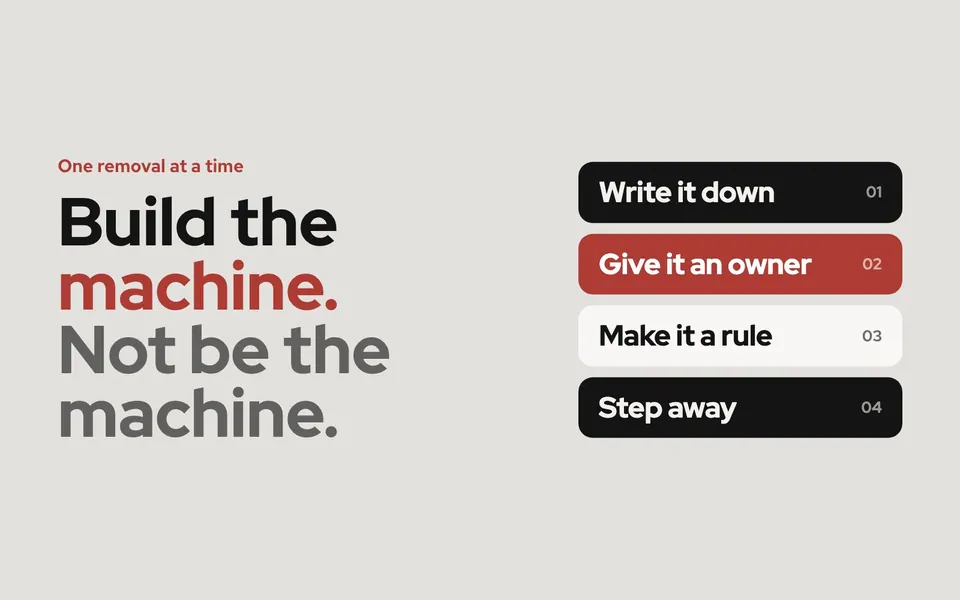
The founder's job is to build the machine, not be the machine. Freedom does not mean doing nothing. It means choosing what you do: strategy, key relationships and growth instead of operations, emails and fires. If you spent more than ten hours last week on work someone else could do, read You're Not a CEO. You're the Highest-Paid Employee. next.
Where to start this week
If you only do one thing: pick the one task you would remove with a magic wand, record yourself doing it the next time it comes up, and hand it to one owner with one outcome and one deadline.
If you are not sure which area is holding you back, take the Founder Bottleneck Scorecard. And if you already know it is you and want help getting out of the way, that is exactly what I do in business coaching.
Frequently asked questions
Can my business run without me?
If you took two weeks off and things would slip or stall, not yet. Other signs it still runs through you: work waits for your approval, handoffs come back unfinished or done wrong, and how your key work gets done lives in your head, not in a written process.
What is the first step to make a business run without you?
Pick one thing to remove. If you had a magic wand to remove yourself from one task by next Friday, what would it be? Start there. Record yourself doing it, turn that into a step by step process, and hand it to one owner with one outcome and one deadline.
What should I hand off first?
Start with the area where the business leans on you hardest. For most founders that is decisions: pick the approval that waits on you most often, write down the rule you actually use to decide it, and hand over the rule along with the authority to use it.
How do I test whether my business can run without me?
Step away on purpose, in steps that get longer: a day, then a week, then two. Before each one, agree with your team on what counts as a real emergency, so everything else gets decided without you. Every question that waited for you points at the next process to write.