What is a decision rights framework? A decision rights framework is a written map of who gets to make which decisions in your business, within what limits, and who needs to be told afterward. Founders use one to move routine decisions off their desk: each decision gets an owner, a rule to decide it by, a limit, and a way to report back.
That is the short answer. The longer one is that most founders already have a decision rights framework. It just has one line in it: "Ask me." Every approval, fix and call routes through the founder, so the business can only move as fast as one person can think. A real framework replaces that one line with a short list your team can actually use.
Here is what decision rights mean, a simple four-level way to sort them, how to build your first version in an afternoon, and how to tell whether it is working.
What does "decision rights" mean?
Decision rights are the authority to make a decision and the accountability for how it turns out. Researchers at the MIT Center for Information Systems Research describe them as the rights that determine who has the authority and accountability for key decisions in an organization.
Both halves matter. Authority without accountability means people make calls and nobody owns the result. Accountability without authority is worse: someone is responsible for an outcome but still has to come to you for permission at every step. That is how you end up with a team that brings you problems instead of decisions.
In a large company, decision rights get written into governance documents and committee charters. In a founder-led business doing somewhere between $500K and $5M, they usually live in one place: your head. The framework is how you get them out.
Why do founders need a decision rights framework?
Because the first bottleneck in almost every founder-led business is decisions. You are the decision engine. Work waits for your approval before it can move forward. Your team brings you problems to solve, not decisions they have already made. When you are busy, everything stops.
None of that happens because your team is weak. It happens because nobody ever told them, in writing, what they are allowed to decide. So they do the safe thing and ask. And every time you answer, you teach them to ask again.
If your team cannot move without you, you do not have a team. You have an audience. A decision rights framework is the simplest way to change that, because it does not ask anyone to guess where the line is. It draws the line.
The four levels of decision rights
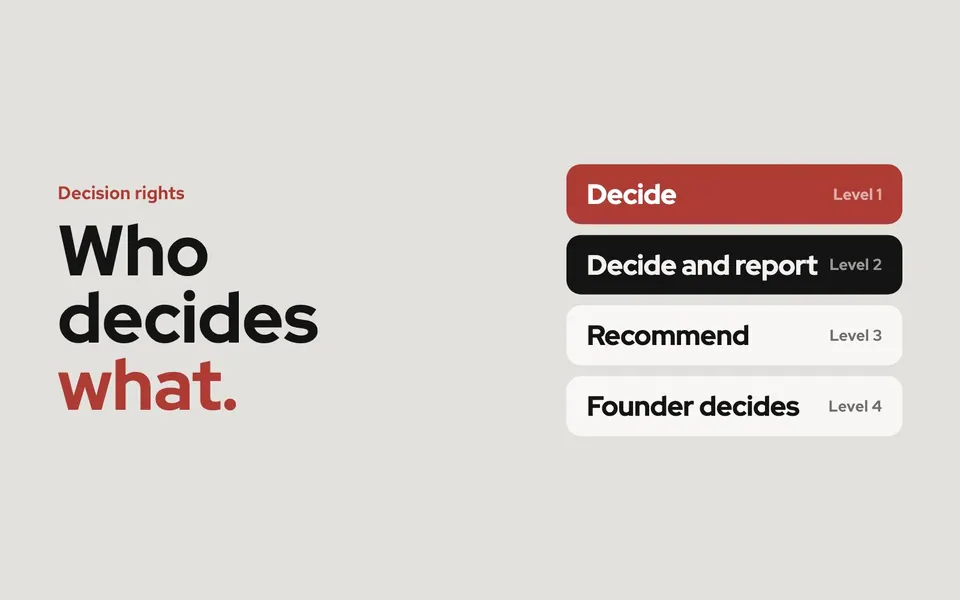
Not every decision should be handed over the same way. A simple way to sort them is four levels, from fully handed off to fully yours:
| # | Level and what it means |
|---|---|
| 1 | Decide: The owner decides and acts. You are not involved, and you see it only in the weekly numbers, if at all. |
| 2 | Decide and report: The owner decides and acts, then tells you at the weekly check-in what they did and why. |
| 3 | Recommend: The owner does the work and brings you a recommendation before the decision is made. You make the final call. |
| 4 | Founder decides: You decide. Others give input. |
The goal is not to push everything to level 1 on day one. The goal is to put every recurring decision at a level on purpose, then move decisions down a level as trust is earned. Sort honestly and you may find that more of your decisions belong at levels 1 and 2 than you expected.
The same four levels work for software. If you are setting up an AI chief of staff, the levels describe what it may do alone, what it drafts for your approval and what stays with you.
Level 4 should be a short list: strategy, key relationships, closing major deals, and the hires who will lead others. That is CEO work. Everything else is a candidate to move.
How to build a decision rights framework in an afternoon
You do not need a consultant or a governance committee to start. You need a page and two hours.
- List the decisions that waited on you. Go back through the last two weeks of messages, emails and meetings. Write down every time someone needed your answer before they could move. Approvals, pricing questions, schedule changes, refunds, vendor choices, small hires. All of it.
- Find the three that come up most. Circle the three decisions you make most often each week. Those are where a framework pays off fastest, because they are the ones blocking your team most often.
- Write down the rule you actually use. For each of the three, write the criteria you already apply in your head. What do you check? What makes it a yes? What makes it a no? If you cannot write the rule, the decision is not ready to hand over yet, and that tells you something too.
- Give each one an owner, a level and a limit. One person, not "the team." A level from the table above. And a limit, such as a dollar amount, a customer type or a timeframe. Inside the limit, they decide. Outside it, it moves up a level.
- Agree on what counts as an emergency. Decide with your team what is truly urgent enough to interrupt you. Everything else waits for the check-in or gets decided without you.
- Review it every week. At your weekly check-in, look at what got decided and what still came back to you. Every question that waited for you points at the next rule to write.
Start with three decisions, not thirty. A short framework your team uses beats a long one nobody opens.
Decision rights framework vs. RACI vs. a delegation matrix
These three tools get mixed up, but each one answers a different question.
- RACI (responsible, accountable, consulted, informed) assigns roles on a task or project. It answers "who does what on this piece of work?"
- A delegation matrix sorts your tasks into four boxes: eliminate, automate, delegate and focus. It answers "should this work exist, and who or what should do it?"
- A decision rights framework sorts decisions, not tasks. It answers "who gets the final say, inside what limits, and who hears about it?"
They work best together. The delegation matrix tells you which work to hand off. The decision rights framework makes sure the person you handed it to can actually finish it without coming back to you for permission.
Which decisions should a founder keep?
Keep the decisions that only you can make: where the company is going, the relationships and deals that shape it, and the people who will lead others. Keep decisions that are expensive or hard to reverse until you have written the rule and seen someone use it well.
Hand off the decisions that are frequent, follow a pattern and can be undone. If someone on your team can make the call about 80% as well as you would, give it to them. That remaining 20% is not worth your calendar. Your standards should apply to outcomes, not to how each call gets made.
Common mistakes when founders set decision rights
- Handing over the decision but keeping a veto. If you overrule the first few calls, your team learns the framework is decoration and goes back to asking.
- Giving authority without the rule. "You decide" with no criteria feels like a test. Hand over the rule along with the authority to use it.
- No limit. Without a dollar amount or boundary, people either freeze or overreach. A clear limit makes it safe to decide.
- Checking in on everything anyway. If you hand off a decision and then ask about it three times a day, nothing moved. If that habit is the hard part, read how to stop micromanaging your team.
Some decisions will go a way you would not have chosen. That is the price of a team that can think, and it is much cheaper than a business that stops whenever you are busy.
How do you know it is working?
Track whether decisions are moving away from you, not just whether tasks are getting done. Count how many questions reached you this week compared with last week. If the number is falling and the business is still moving, it is working.
Then test it. Take one week and do not answer a single question your team could plausibly figure out on their own. You will see which rules hold, which ones need rewriting, and who on your team was capable the whole time and never got the room to prove it. When decisions stop waiting on you, you are a long way toward a business that runs without you.
Where to start this week
If you only do one thing: pick the one approval that waits on you most often, write down the rule you use to decide it, and hand it to one owner with a clear limit. That is your first line of a real decision rights framework.
If you are not sure whether decisions are your biggest constraint, take the free Founder Bottleneck Scorecard. It scores you on decisions, delegation, systems, automation and time. Every decision running through you is the first of the five bottlenecks that keep founders stuck between $500K and $5M. And if you already know the decisions run through you and want help getting out of the way, that is what I do in business coaching.
Frequently asked questions
What is a decision rights framework?
A decision rights framework is a written map of who makes which decisions in a business, within what limits, and who needs to be told afterward. It gives each recurring decision an owner, a rule to decide it by, a limit and a way to report back, so routine decisions stop waiting on the founder.
What is the difference between decision rights and RACI?
RACI assigns roles on a task or project: who is responsible, accountable, consulted and informed. A decision rights framework sorts decisions, not tasks. It says who gets the final say on each recurring decision, inside what limits, and who hears about it after.
Which decisions should a founder keep?
Keep the decisions only you can make: where the company is going, the key relationships and deals, and the people who will lead others. Hand off decisions that are frequent, follow a pattern and can be undone, especially when someone on your team can make the call about 80% as well as you.
How do I give my team decision rights without losing control?
Hand over the rule along with the authority. Write down the criteria you use, set a clear limit such as a dollar amount, and agree on a weekly check-in where the owner reports what they decided. Inside the limit they decide; outside it, the decision comes back to you.