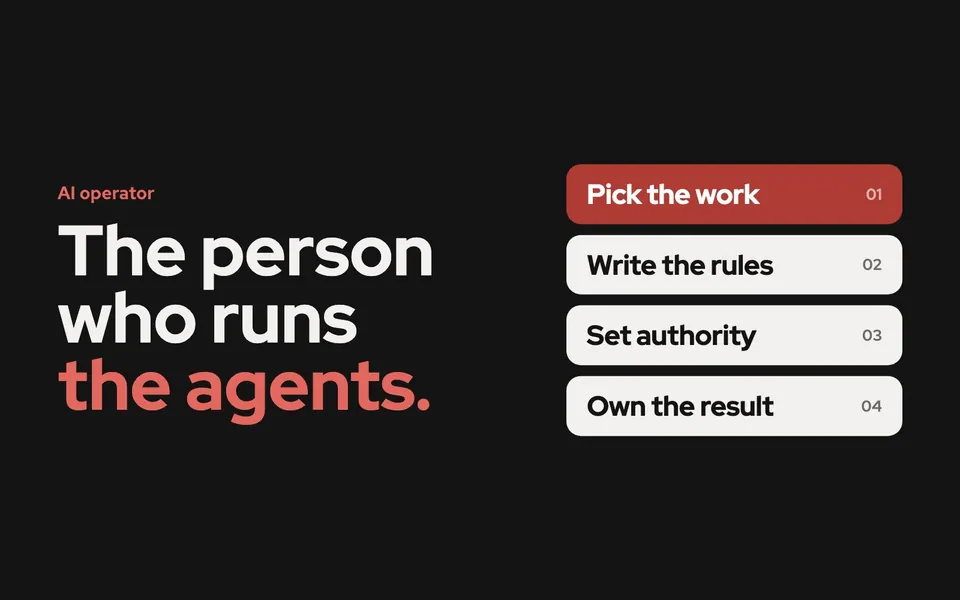
What is an AI operator? An AI operator is the person who decides what work AI agents do in a business, sets the limits on what they may do alone, and owns the results. The operator does not have to write code. The job is judgment: picking the work, writing the rules, checking the output and widening the agents' authority only when they have earned it.
You will also see the phrase used for software. Several AI products that click through websites and fill in forms on their own are sold as "operators." That is a tool. This article is about the person, because the person is the part most businesses are missing.
Here is what an AI operator does, how the role differs from an AI engineer or an AI generalist, the four levels of authority every operator sets, and how a founder can start operating this way.
What does an AI operator do?
An AI operator runs AI the way a good manager runs a team. The work falls into five parts:
- Picking the work. Finding the tasks worth handing to an agent. The best ones are high frequency, rule based and screen heavy: sorting, summarizing, drafting, updating records, chasing follow-ups.
- Writing the context. Agents know only what is written down. The operator writes the priorities, the rules, the tone and the exceptions so the agent stops guessing.
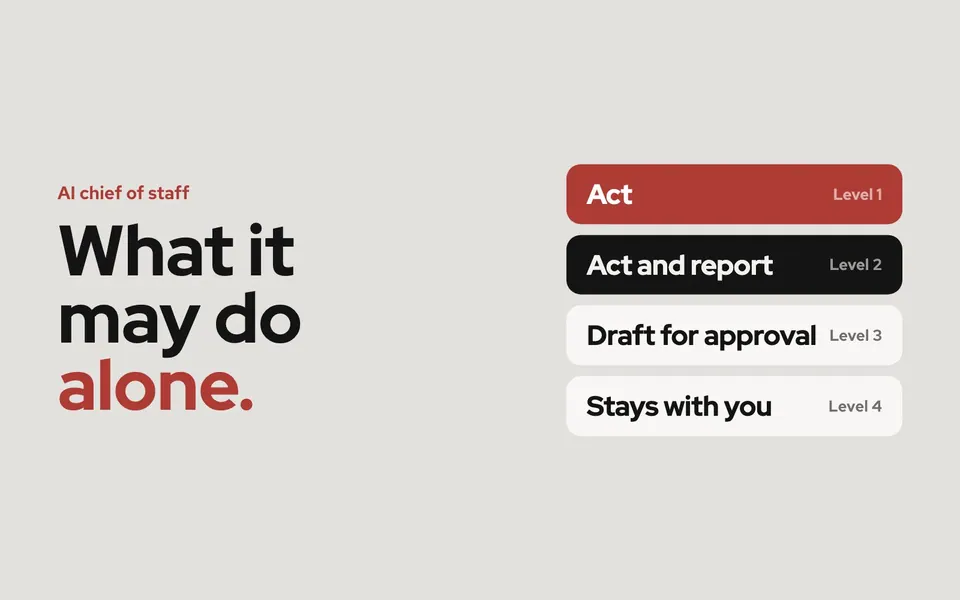
- Setting authority. For every task, the operator decides whether the agent acts alone, acts and reports, drafts for approval, or only gathers facts.
- Checking the output. Reading a sample of what the agents did, finding the mistakes and tracing each one back to a missing rule.
- Owning the result. When an agent gets something wrong, the operator answers for it, the same way a manager answers for a new hire.
None of this is a technical skill. It is the same judgment a founder already uses when handing work to people, pointed at software.
Is an AI operator a person or a piece of software?
Both meanings are in use, which is why the term confuses people.
In product news, an "operator" is usually an AI agent that controls a web browser for you: it opens pages, clicks buttons and completes a task you describe. In business, an AI operator is a role: the person who directs agents like that and is accountable for what they do.
The two meanings fit together. The software does the clicking. The person decides what it should click, what it must never touch, and when its work is good enough to stop checking. A tool with no operator is a demo. A tool with an operator is part of how the business runs.
AI operator vs AI engineer vs AI generalist
These three titles get mixed up in job posts. Here is how I separate them:
| Role | What they do |
|---|---|
| AI operator | Decides what agents do, sets their authority and checks the output. Rarely writes code. Owns the business result. |
| AI engineer | Builds and connects the systems: models, integrations and data. Writes code. Sometimes owns the business result. |
| AI generalist | Uses AI well across many tasks and tools in their own work. Sometimes writes code. Owns the results of their own work. |
An AI generalist is a strong individual user. An AI engineer builds what the operator needs. The AI operator sits between the business and the agents and is the one who says "this task is ready to run on its own." In a small company one person often wears two of these hats, and the founder is usually the operator whether or not anyone calls it that.
The four levels of authority an AI operator sets
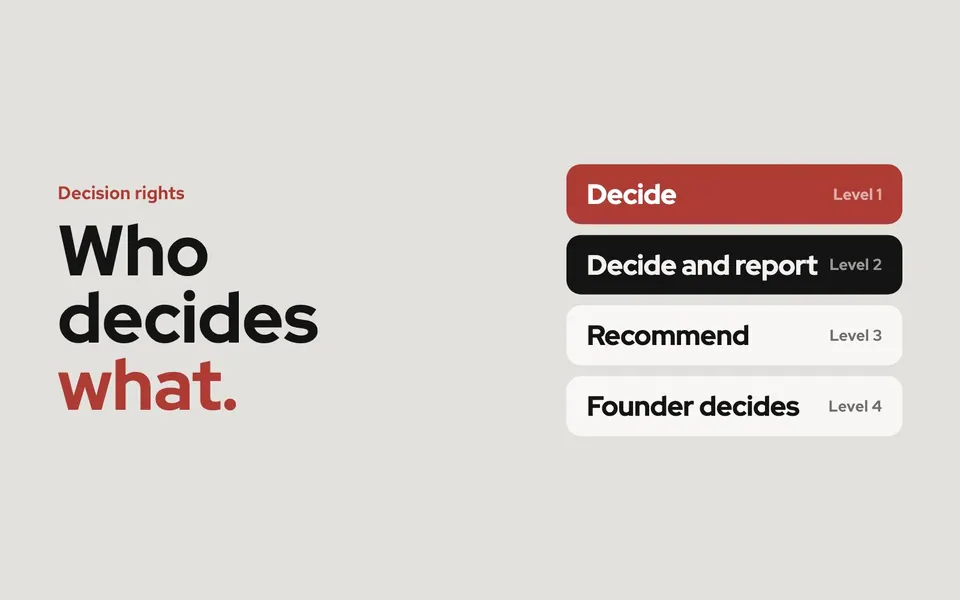
The most important decision an operator makes is not which tool to use. It is how much each agent may do without asking. I use the same four levels I use for people in a decision rights framework, applied to actions instead of decisions:
- Act. The agent does the task and nobody sees it. Filing, tagging, logging notes, updating a tracker.
- Act and report. The agent does the task and lists it in a daily summary. Sending a reminder with wording you already approved, booking a routine meeting inside set hours.
- Draft for approval. The agent prepares the work and waits. Anything that goes to a client, anything with a number in it, anything new under your name.
- Stays with a person. The agent may gather facts, and that is all. Money, hiring and firing, legal matters and anything hard to undo.
A good operator starts almost every task at level 3 and moves it down a level only after the drafts have needed no changes for a couple of weeks. That is how trust is earned with a new employee, and it works the same way here.
Why founders end up as the first AI operator
In most founder-led businesses, nobody else knows enough to do the job yet. The operator has to know which work matters, which clients come first, what the business will and will not do, and where the real risks are. Early on, that knowledge lives in one head.
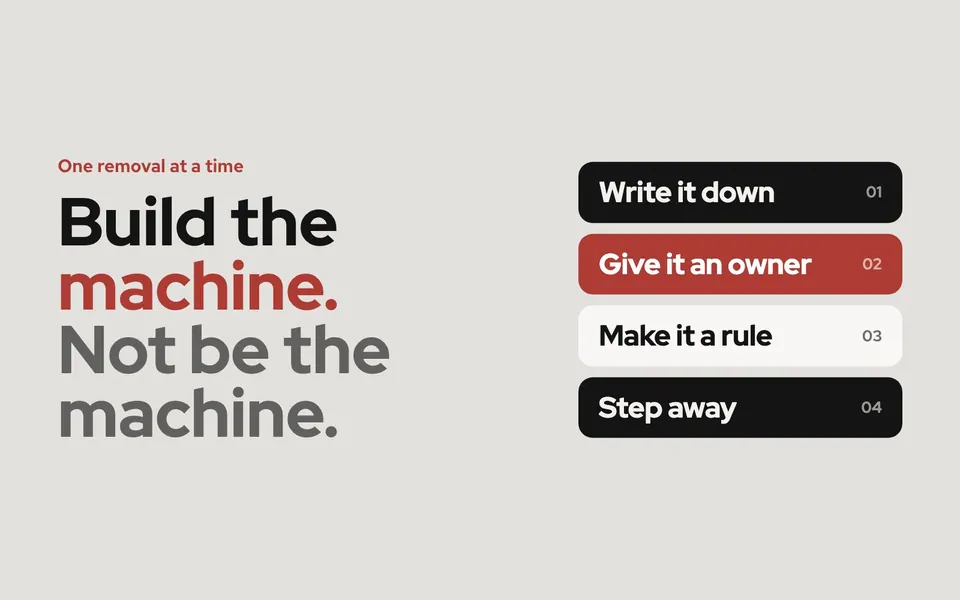
That is also why founders are often the bottleneck for AI, not just for their team. If the rules for a task exist only in your head, no agent can follow them, and no person can either. The work of making a business run without you and the work of operating AI start in the same place: writing the rules down.
The goal is not for the founder to stay the operator forever. Once the context is written and the authority levels are set, the role can move to someone on the team, and the founder becomes the person who approves level 4 decisions.
What skills does an AI operator need?
Fewer technical skills than people assume, and more management skills:
- Clear writing. Instructions an agent can follow are instructions a new hire could follow. Vague rules produce vague work.
- Process sense. Seeing a task as steps, inputs and exceptions, so you can tell which parts are safe to hand off.
- Risk judgment. Knowing what an expensive mistake looks like in your business, and keeping those tasks at level 4.
- Review discipline. Checking a sample of the output every week without falling back into checking everything.
- Comfort with imperfect first drafts. The first version is never right. The operator's job is to make the second one better.
Notice the overlap with good delegation. If you already sort your work with a delegation matrix, you have most of what you need.
How to start operating with AI this month
You do not need a new title or a new hire to start. You need one job running well.
- Pick one recurring job. Something you or your team do every day or every week that is mostly reading, sorting and drafting.
- Write a one-page context. What the job is for, what good looks like, who and what always comes first, and what the agent must never do.
- Start it at level 3. Everything it produces is a draft for a person to approve.
- Review the drafts weekly. Every correction you make becomes a line in the context page.
- Move tasks down a level only when earned. After a couple of weeks with no changes, let a task act and report.
- Then add the next job. One at a time. The context page grows into the operating manual for your agents.
A coordinating job is a good first one. The AI chief of staff guide walks through that setup step by step, from a read-only morning briefing to drafts you approve.
The short version
An AI operator is the person accountable for what AI does in a business. The software can read, draft and act. The operator decides what it may do, writes the rules it follows, checks its work and widens its authority only when it has earned it. In most growing companies, that person is the founder first.
If you would rather have the agents designed, built and kept running for you, that is the work my team does at Ironbridge AI Advisory: we find the work worth automating, build it, and keep it running.
Frequently asked questions
What is an AI operator?
An AI operator is the person who decides what work AI agents do in a business, sets the limits on what they may do alone, and owns the results. The role is about judgment, not code: picking the work, writing the rules, checking the output and widening the agents' authority only when they have earned it.
Is an AI operator a job title or a piece of software?
Both meanings are in use. Some AI products that control a web browser and complete tasks on their own are called operators. In business, an AI operator is the person who directs agents like that and answers for what they do. The software does the work; the operator decides what work it may do.
What is the difference between an AI operator and an AI engineer?
An AI engineer builds and connects the systems: models, integrations and data. An AI operator decides what those systems should do in the business, sets their authority and checks their output. The operator rarely writes code but owns the business result. In a small company one person may do both.
What is an AI generalist?
An AI generalist is someone who uses AI well across many tasks and tools in their own work. A generalist is a strong individual user; an AI operator goes further and runs agents on behalf of the business, with written rules and levels of authority for each task.
Do you need to know how to code to be an AI operator?
No. The core skills are clear writing, process sense, risk judgment and steady review. You need to describe a task well enough that an agent can follow it, know which tasks are too risky to hand off, and check a sample of the work every week. An engineer can build what you need.